





Your phone lives in your pocket, your bag, or a cup holder. Your dash cam lives on the hottest surface in your car, in direct sun, all day, every day. Most people never think about what that does to the electronics inside — until the camera stops recording in August, or the housing starts to bulge.
The part that decides how a dash cam handles heat is not the sensor or the chip. It is the small energy store that keeps the camera alive for a few seconds after power cuts out. There are two ways to build it: a lithium battery or a supercapacitor. For a car parked in the sun, the difference is not small.
This guide explains what that component does, how each type behaves in heat, and why the AKEEYO XPRO uses a supercapacitor.
How hot does the inside of a parked car actually get?
Hotter than most drivers expect, and faster. Researchers from Arizona State University and UC San Diego measured parked cars on summer days in Tempe, Arizona, with outdoor temperatures above 100°F. After one hour in the sun, cabin air averaged about 116°F. The dashboard averaged around 157°F, and the study notes dashboards can pass 165°F in about an hour. (Scripps Institution of Oceanography, UC San Diego)
A dash cam sits in that same zone: against the windshield, in full sun, on or near the dash. For a RAV4 parked at work from nine to five in Texas, Arizona, or inland California, those numbers are a normal Tuesday, not an edge case.
Heat is not the only extreme. The same camera has to wake up on a January morning in Minnesota or Alberta, when the cabin is well below freezing. A component that only works comfortably at room temperature is the wrong part for the job.

What does a dash cam's battery or capacitor actually do?
A common misunderstanding is that a dash cam runs on its battery. It does not. While you drive, the camera draws power from the car. The internal battery or capacitor has one main job: when power cuts out — you switch off the ignition, a fuse blows, or a collision knocks the cable loose — it keeps the camera alive for a few seconds so it can finish writing the current video file and shut down cleanly.
That last step matters more than it sounds. A video file that is cut off mid-write can be corrupted and unplayable. If that file is the one from the moment of a crash, the camera has failed at the only thing you bought it for.
So the question is not "which one stores more energy." Both store enough for a clean shutdown. The question is which one still does its job after a thousand hot afternoons.
Supercapacitor vs lithium battery: how they behave in heat
Lithium battery. A lithium-ion or lithium-polymer cell stores energy through a chemical reaction. That reaction is sensitive to temperature. Heat speeds up the chemistry that wears a cell out, so a battery that spends every day at dashboard temperatures loses capacity faster than one kept cool. Push the heat further and the cell can swell, which is the bulging housing some dash cam owners notice after a summer or two. Lithium cells also charge poorly, or not at all, outside a fairly narrow temperature window, so a camera may refuse to charge its own backup on the days it needs it most.

The upside of a battery is that it holds more energy. A lithium-battery dash cam can usually record for a short while with the car off and no cable attached, which is handy if you want to step out and film damage after an incident.
Supercapacitor. A supercapacitor stores energy as an electrical charge rather than a chemical reaction. There is no chemistry to speed up, so it tolerates a much wider temperature range in both directions. It charges in seconds, does not swell, and survives far more charge-and-discharge cycles than a battery. The trade-off is capacity: it stores only enough for the camera to save the file and shut down, not enough to keep recording unplugged.
For a device whose whole purpose is to work reliably on the hottest and coldest days of the year, that trade-off favors the supercapacitor. The only thing you give up is a feature most drivers never use, and you gain a camera that is far less likely to quit, swell, or lose a file when the cabin hits 150°F.
Why the operating temperature range matters more than the spec sheet suggests
Every dash cam lists an operating temperature range. Many buyers skip it. On a hot-climate vehicle, it is one of the most important lines on the sheet.
The XPRO is rated to operate from -20°C to +70°C (-4°F to 158°F). Set that against the Arizona study: dashboard surfaces averaging 157°F after an hour. A camera rated to 50°C or 60°C is already past its limit in that scenario, which is why some dash cams shut down, throw errors, or record intermittently in midsummer. A 70°C rating covers the dashboard numbers the study measured, with the supercapacitor behind it rather than a battery that is degrading on every one of those days.
The cold end matters too. At -20°C a lithium cell may not charge at all. A supercapacitor does not have that problem, so the camera is ready on the first cold start of winter without a warm-up period.
What happens to your footage if the power cuts out?
This is where the energy store and the firmware meet. The XPRO includes power-loss protection: if power is cut unexpectedly, the file being written is saved intact rather than corrupted. The supercapacitor supplies the few seconds that makes this possible, and it does so whether the car is at -20°C or +70°C.
Pair that with the G-sensor. When the camera detects an impact, it locks the clip so the normal recording loop cannot overwrite it. Between the two, the footage from a collision is both saved cleanly and protected from being recorded over — the two failure points that matter most when you actually need the file.
If you plan to add parking monitoring with the optional OBD or hardwire cable, this becomes more important, not less. A camera on parking duty is drawing power for hours in a sealed, sun-heated cabin. That is the harshest routine a dash cam can have, and it is where a supercapacitor design earns its keep.

Why the XPRO uses a supercapacitor
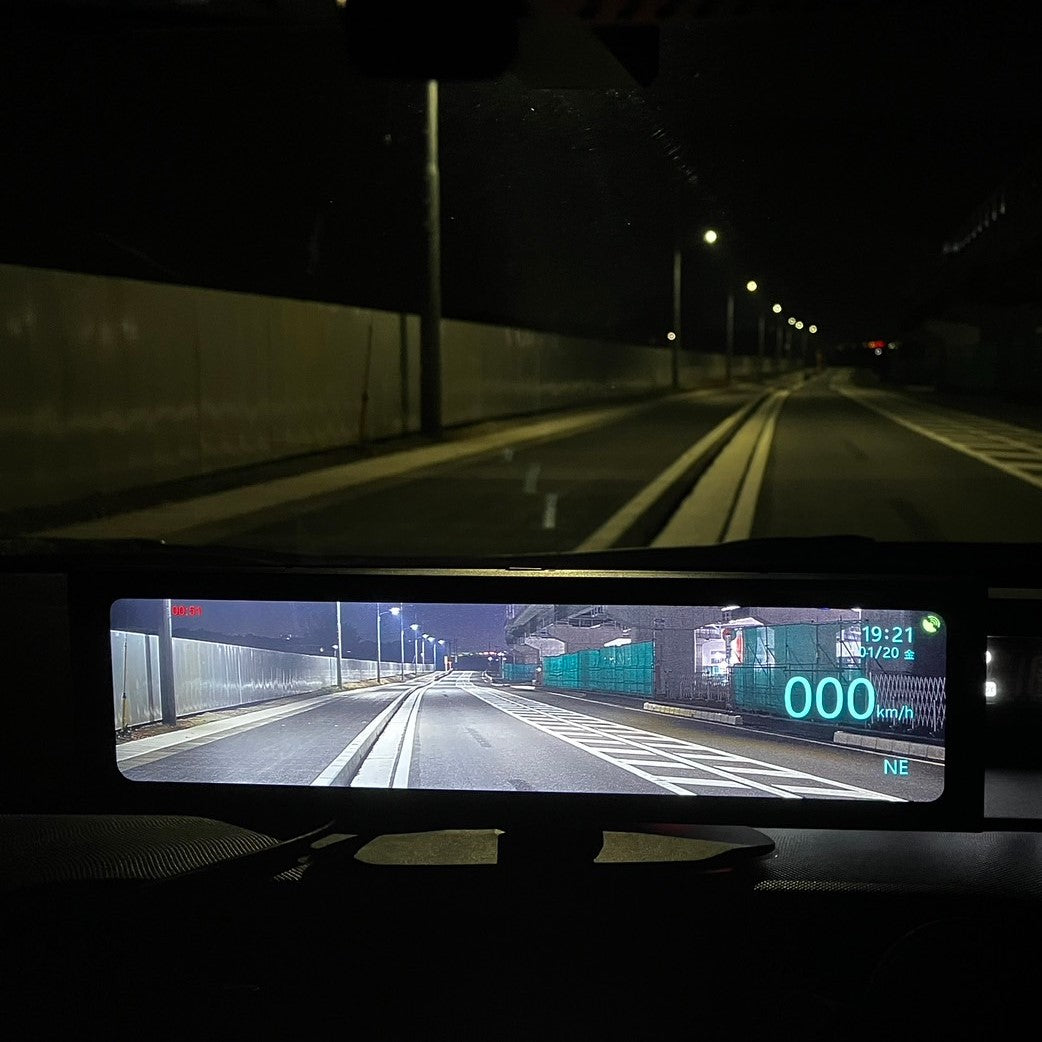
The XPRO was designed to replace the mirror base in a Toyota RAV4 and other vehicles — a position at the top of the windshield, in full sun, with no airflow around it. A camera that lives there for five or ten years cannot rely on a component that degrades every summer.
Three design choices work together:
- Supercapacitor energy store — no chemical reaction, no swelling, consistent performance across the full temperature range.
- -20°C to +70°C operating range — rated for the dashboard temperatures measured in real parked cars, and for sub-zero starts.
- Power-loss protection and collision lock — the file is saved cleanly and protected from the loop, whatever caused the power to cut.
None of these shows up in a resolution number or a sample video. They show up in year three, when the camera still records every day and the file from the one incident that mattered is there and plays.
Which type should a RAV4 owner in a hot climate choose?
If your vehicle regularly sits in direct sun — a commuter lot, a driveway without shade, anywhere in the Sun Belt from May to September — a supercapacitor dash cam is the safer long-term choice. It will not swell, it will not refuse to charge on the hottest days, and it will keep saving files cleanly as the years go by.
A lithium-battery camera makes sense only if you specifically need to record for a few minutes with the car off and no power, and you park somewhere cool enough that heat is not a daily event. For most RAV4 owners, that describes a feature they will rarely use and a risk they will face every summer.
Check the operating temperature range and the energy store type before you check the resolution. In a hot car, those two lines on the spec sheet decide whether the camera is still working when you need it.


Leave a comment
All comments are moderated before being published.
This site is protected by hCaptcha and the hCaptcha Privacy Policy and Terms of Service apply.